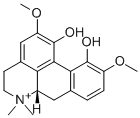
PRODUCT Properties
| Melting point: | 252℃ |
| storage temp. | 2-8°C(protect from light) |
| solubility | Soluble in Chloroform,Dichloromethane,Ethyl Acetate,DMSO,Acetone,etc. |
| form | Powder |
| Major Application | metabolomics vitamins, nutraceuticals, and natural products |
| InChI | 1S/C20H23NO4/c1-21(2)8-7-12-10-15(25-4)20(23)18-16(12)13(21)9-11-5-6-14(24-3)19(22)17(11)18/h5-6,10,13H,7-9H2,1-4H3,(H-,22,23)/p+1/t13-/m0/s1 |
| InChIKey | YLRXAIKMLINXQY-ZDUSSCGKSA-O |
| SMILES | OC1=C(OC)C=C2CC[N+](C)(C)[C@@]3([H])CC4=CC=C(OC)C(O)=C4C1=C32 |
Description and Uses
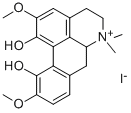
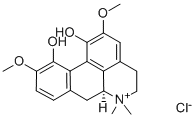
A wide variety of species contain this quaternary alkaloid which is widespread among the families, Aquilegia, Magnolia and Michelia. It has been isolated and characterized as the iodide, m.p. 248-9°C (dec.); [0:11>5 + 200.1° (MeOH). The optically inactive base also yields an iodide which crystallizes with 1.5 H20, m.p. 243°C (dec.).
Magnoflorine-d3 is the labelled analogue of Magnoflorine, an isoquinoline alkaloid from the Coptis japonica and it enhances the myoblast differentiation through activation of the p38 MAP kinase and Akt pathway.
Safety
| Symbol(GHS) |   GHS07,GHS08 |
| Signal word | Warning |
| Hazard statements | H315-H319-H341 |
| Precautionary statements | P501-P202-P201-P264-P280-P302+P352-P308+P313-P337+P313-P305+P351+P338-P362+P364-P332+P313-P405 |
| WGK Germany | WGK 3 |
| Storage Class | 11 - Combustible Solids |
| Hazard Classifications | Acute Tox. 4 Dermal Acute Tox. 4 Inhalation Acute Tox. 4 Oral |