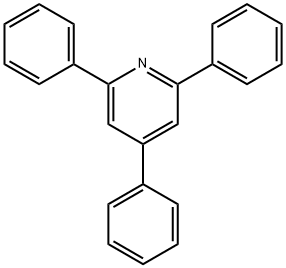
2,4,6-TRIPHENYLPYRIDINE , 98% , 580-35-8
| Pack Size | Price | Stock | Quantity |
| 250MG | RMB228.00 | In Stock |
|
| 1g | RMB498.40 | In Stock |
|
| 5g | RMB1583.20 | In Stock |
|
| 25g | RMB5519.20 | In Stock |
|
| others | Enquire |
PRODUCT Properties
| Melting point: | 139.0 to 143.0 °C |
| Boiling point: | 220-230 °C(Press: 0.3 Torr) |
| Density | 1.103±0.06 g/cm3(Predicted) |
| storage temp. | Sealed in dry,Room Temperature |
| form | powder to crystal |
| pka | 3.95±0.10(Predicted) |
| color | White to Almost white |
| λmax | 312nm(EtOH)(lit.) |
| InChI | InChI=1S/C23H17N/c1-4-10-18(11-5-1)21-16-22(19-12-6-2-7-13-19)24-23(17-21)20-14-8-3-9-15-20/h1-17H |
| InChIKey | FRZHWQQBYDFNTH-UHFFFAOYSA-N |
| SMILES | C1(C2=CC=CC=C2)=NC(C2=CC=CC=C2)=CC(C2=CC=CC=C2)=C1 |
Description and Uses
2,4,6-Triphenylpyridine, as a well-known electron-deficient heterocyclic unit, has been widely used as the conjugated molecular bridge linker to the polymer main chain. Pyridine and aromatic heterocyclic derivatives have been widely used as electron transporting/hole blocking materials in LED devices and LED blends because these units have many excellent properties of being a better chromophore, with high electron affinity, high thermal and oxidative stability, and ability for good charge injection and transporting building blocks[1].
In addition, introduction of the pyridinyl moiety into the polymer backbone not only increases the electron affinity of the polymer, which makesthepolymer moreresistantto oxidation and also gives the polymer better electron-transporting properties, but also avoids fluorescence quenching due to the intersystem crossing (ISC) effect of the heavy atom. Some of them have been introduced into the polymer backbones to realize the desirable opto electronic materials.
2,4,6-Triphenylpyridine is a pyridine compound that acts as a neutral leaving group in palladium(0)-catalysed nucleophilic allylation reactions. In addition, three novel conjugated polymers based on the 2,4,6-triphenylpyridine moiety can be synthesised via the palladium-catalysed Sonogashira coupling reaction. These three polymers, P-1, P-2 and P-3, all exhibit strong fluorescence emission, characterised by a large Stokes shift and high quantum yield.
Safety
| Symbol(GHS) |   GHS05,GHS06 |
| Signal word | Danger |
| Hazard statements | H315-H335-H413-H318-H301 |
| Precautionary statements | P264-P270-P301+P310-P321-P330-P405-P501-P280-P305+P351+P338-P310-P264-P280-P302+P352-P321-P332+P313-P362 |
| HS Code | 2933.39.9200 |