BD4573541
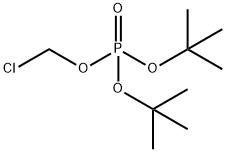
Di-tert-butylchloromethylphosphate , 95% , 229625-50-7
| Pack Size | Price | Stock | Quantity |
| 1g | RMB53.60 | In Stock |
|
| 5g | RMB264.00 | In Stock |
|
| 10g | RMB510.40 | In Stock |
|
| 25g | RMB789.60 | In Stock |
|
| 100g | RMB3103.20 | In Stock |
|
| others | Enquire |
Update time: 2022-07-08
PRODUCT Properties
| Boiling point: | 272.9±23.0 °C(Predicted) |
| Density | 1.115±0.06 g/cm3(Predicted) |
| storage temp. | Inert atmosphere,2-8°C |
| solubility | Benzene (Slightly), Methanol (Slightly) |
| form | clear liquid |
| color | Colorless to Light yellow |
| Stability: | Moisture Sensitive |
| InChI | InChI=1S/C9H20ClO4P/c1-8(2,3)13-15(11,12-7-10)14-9(4,5)6/h7H2,1-6H3 |
| InChIKey | LNJAJHJFSKUCIR-UHFFFAOYSA-N |
| SMILES | P(OC(C)(C)C)(OC(C)(C)C)(OCCl)=O |
| CAS DataBase Reference | 229625-50-7 |
Description and Uses
Di-tert-butyl Chloromethyl Phosphate has become one of the most common reagents to prepare phosphon-oxymethyl pro-drugs, generally by direct alkylation of hydroxyl or amino groups. Its synthesis was first reported in 1999 via a reaction of di-tert-butyl tetramethylammonium phosphate with chloroiodomethane. This approach required the use of the corresponding tetramethylammonium phosphate and a vast excess (>11 equiv) of chloroiodomethane to minimize the formation of tetra-tert-butyl methylene bisphosphate[1].
Used as an intermediate for laboratory research.
Safety
| Symbol(GHS) |  GHS07 |
| Signal word | Warning |
| Hazard statements | H302-H315-H319-H335 |
| Precautionary statements | P261-P305+P351+P338 |
| Hazard Codes | Xn |
| Risk Statements | 20/21/22 |
| Safety Statements | 36/37 |
| HS Code | 29199000 |