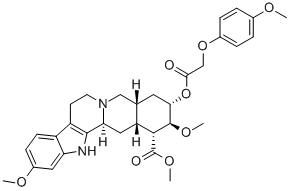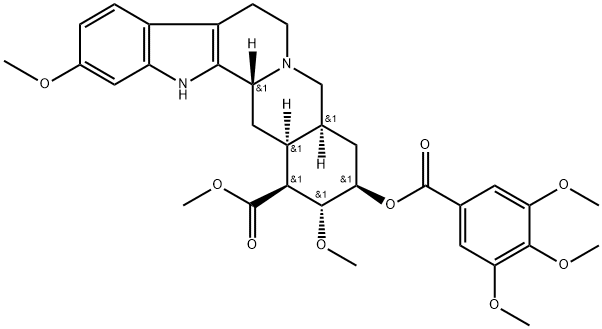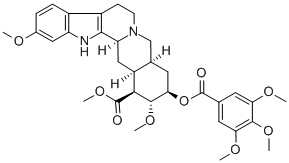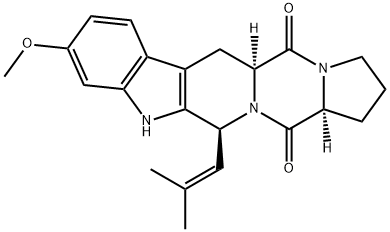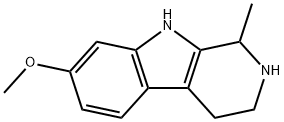
LN-498122
tetrahydroharmine , 0.97 , 17019-01-1
Update time: 2023-04-23
PRODUCT Properties
| Melting point: | 199 °C |
| Boiling point: | 399.2±37.0 °C(Predicted) |
| Density | 1.145±0.06 g/cm3(Predicted) |
| storage temp. | Amber Vial, -20°C Freezer, Under inert atmosphere |
| solubility | Chloroform (Slightly, Heated), DMSO (Slightly), Methanol (Slightly) |
| pka | 18.03±0.40(Predicted) |
| form | Solid |
| color | White to Off-White |
| Stability: | Light Sensitive |
Description and Uses
This carboline alkaloid is present in Banisteria caapi, a plant indigenous toSouth America. It is dextrorotatory with [o:]l>s + 32° (c 1.0, CHCI3). One methoxyl group, a methyl group and two imino groups are present in the molecule.
Tetrahydroharmine is a β-Carboline derivative. β-Carboline alkaloids are inhibitors of human monoamine oxidase enzymes. β-carboline derivatives were also reported to have antiviral and fungicidal activity. Tetrahydroharmine is related to 3,4-Dihydroharmine (D449718).
Safety
| Symbol(GHS) |    GHS02,GHS06,GHS08 |
| Signal word | Danger |
| Hazard statements | H225-H301+H311+H331-H370 |
| Precautionary statements | P210-P233-P280-P301+P310-P303+P361+P353-P304+P340+P311 |
| target organs | Eyes,Central nervous system |
| WGK Germany | WGK 2 |
| Storage Class | 3 - Flammable liquids |
| Hazard Classifications | Acute Tox. 3 Dermal Acute Tox. 3 Inhalation Acute Tox. 3 Oral Flam. Liq. 2 STOT SE 1 |