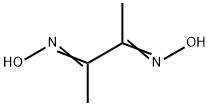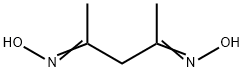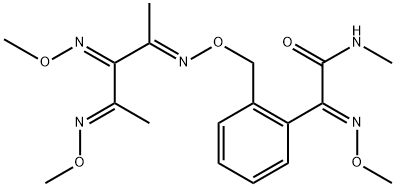
Orysastrobin , 248593-16-0
Synonym(s):
(2E)-2-(Methoxyimino)-2-{2-[(3E,5E,6E)-5-(methoxyimino)-4,6-dimethyl-2,8-dioxa-3,7-diazanona-3,6-dien-1-yl]phenyl}-N-methylacetamide
PRODUCT Properties
| Melting point: | 97~101℃ |
| Density | 1.16±0.1 g/cm3(Predicted) |
| solubility | DMSO (Slightly), Methanol (Slightly) |
| pka | 11.26±0.46(Predicted) |
| form | Solid |
| color | White to off-white |
| BRN | 11330196 |
| Henry's Law Constant | 2.9×10⁵ mol/(m3Pa) at 25℃, Ebert et al. (2023) |
| Major Application | agriculture environmental |
| InChI | 1S/C18H25N5O5/c1-12(20-25-4)16(22-26-5)13(2)21-28-11-14-9-7-8-10-15(14)17(23-27-6)18(24)19-3/h7-10H,11H2,1-6H3,(H,19,24)/b20-12+,21-13+,22-16+,23-17+ |
| InChIKey | JHIPUJPTQJYEQK-ZLHHXESBSA-N |
| SMILES | CNC(=O)C(=N\OC)\c1ccccc1CO\N=C(C)\C(=N\OC)\C(C)=N\OC |
Description and Uses
Orysastrobin is a rice fungicide. It has a moderate aqueous solubility, is volatile and, based on its chemical properties, is mobile and can be expected to leach to groundwater. It is generally moderately persistent in soil systems but will not usually persist in aquatic systems under certain conditions. It is not generally susceptible to hydrolysis. It has a moderate mammalian toxicity and has a high potential to bioaccumulate. It is moderately toxic to most aquatic species, birds and earthworms but relatively non-toxic to honeybees.
Orysastrobin is a fungicide used in the treatment of blast and sheath blight in transplanted rice inhibiting the mitochondrial respiration chain.
Safety
| Symbol(GHS) |    GHS07,GHS08,GHS09 |
| Signal word | Warning |
| Hazard statements | H302+H332-H351-H410 |
| Precautionary statements | P201-P202-P273-P301+P312-P304+P340+P312-P308+P313 |
| Hazard Codes | Xn,N |
| Risk Statements | 20/22-40-50/53 |
| Safety Statements | 22-36/37-46-61 |
| RIDADR | UN 3077 9 / PGIII |
| WGK Germany | 3 |
| Storage Class | 11 - Combustible Solids |
| Hazard Classifications | Acute Tox. 4 Inhalation Acute Tox. 4 Oral Aquatic Acute 1 Aquatic Chronic 1 Carc. 2 |