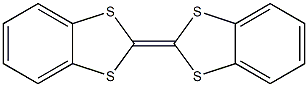
S412279
Dibenzotetrathiafulvalene , 97% , 24648-13-3
Synonym(s):
[2,2’]Bi[benzo[1,3]dithiolylidene];DBTTF
| Pack Size | Price | Stock | Quantity |
| 500mg | RMB1135.57 | In Stock |
|
| others | Enquire |
Update time: 2022-07-08
PRODUCT Properties
| Melting point: | 239-243 °C |
| Boiling point: | 367.1±42.0 °C(Predicted) |
| Density | 1.538±0.06 g/cm3(Predicted) |
| form | solid |
| InChI | 1S/C14H8S4/c1-2-6-10-9(5-1)15-13(16-10)14-17-11-7-3-4-8-12(11)18-14/h1-8H |
| InChIKey | OVIRUXIWCFZJQC-UHFFFAOYSA-N |
| SMILES | S1C(\Sc2ccccc12)=C3/Sc4ccccc4S3 |
Description and Uses
Dibenzotetrathiafulvalene(DBTTF, also known as 1,3-Benzodithiole,2-(1,3-benzodithiol-2-ylidene)-) is an organic electronic material that can be used to form semiconductor charge transfer salts with electron accepting (n-type) materials (TCNQ and F4TCNQ). It can also be used to form charge transfer complexes (TCNQ and DDQ) with a variety of semiconductor crystals for the manufacture of organic field effect transistors (OFETs) and organic light emitting diodes (OLEDs).
Safety
| Symbol(GHS) |  GHS09 |
| Signal word | Warning |
| Hazard statements | H410 |
| Precautionary statements | P273-P501 |
| PPE | Eyeshields, Gloves |
| Hazard Codes | N |
| Risk Statements | 50/53 |
| Safety Statements | 60-61 |
| RIDADR | UN 3077 9/PG 3 |
| WGK Germany | 3 |
| Storage Class | 11 - Combustible Solids |
| Hazard Classifications | Aquatic Acute 1 Aquatic Chronic 1 |