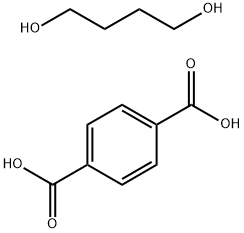
PolybutyleneTerephthalate , (PBT),monofilament,diam.0.8 mm,L200 m
Synonym(s):
;PBT;SCFR
CAS NO.:
Empirical Formula: C12H16O6
Molecular Weight: 256.25
MDL number: MFCD00084365
EINECS: 607-857-5
| Pack Size | Price | Stock | Quantity |
| 1EA | RMB8527.81 | In Stock |
|
| others | Enquire |
PRODUCT Properties
| Melting point: | 226 °C |
| Density | 1.31 g/mL at 25 °C(lit.) |
| storage temp. | -70°C |
| form | pellets |
| biological source | human |
| Specific Activity | 6-8nmol/min·mg |
| Cosmetics Ingredients Functions | VISCOSITY CONTROLLING FILM FORMING |
| InChI | InChI=1S/C8H6O4.C4H10O2/c9-7(10)5-1-2-6(4-3-5)8(11)12;5-3-1-2-4-6/h1-4H,(H,9,10)(H,11,12);5-6H,1-4H2 |
| InChIKey | PCVVBHUFWPHCAL-UHFFFAOYSA-N |
| SMILES | C(C1C=CC(C(=O)O)=CC=1)(=O)O.C(CO)CCO |
| CAS DataBase Reference | 26062-94-2 |
| EPA Substance Registry System | Terephthalic acid 1,4-butanediol polymer (26062-94-2) |
Description and Uses
Polybutylene terphthalate (PBT; Poly(butylene terephthalate)) is a semicrystalline thermoplastic polyester considered as a medium performance engineering polymer. It is produced industrially in a two-step batch or continuous process. The first step involves the transesterification of dimethyl terephthalate (DMT) with 1,4-butanediol (BDO) to produce hydrobutyl terephtlate (bis-HBT) at a temperature of 200°C. The second step consists to the polycondensation of bis-HBT at 250°C to yield PBT. It exhibits both excellent electrical properties and chemical resistance. When reinforced with glass fibers, it has improved stiffness and mechanical strength. Typical uses include connectors, capacitors and cable enclosures. PBT is also used in hot appliances such as iron and kettles.
Polybutylene terephthalate (PBT) resin is widely used in the automotive, electronics, electrical, machinery, and instrumentation industries to manufacture various structural parts and components. It is also used to produce filaments and films. Glass fiber reinforced PBT with added flame retardants is extensively used in flame-retardant components for televisions, such as output transformer frames and bases, various electrical connectors and switches, potentiometers, strip connectors, and color picture tube sockets. PBT can be blended with other polymers to create plastic alloys, with the largest market being the automotive industry, such as for car bumpers and ignition components. These alloys are also increasingly being used in the food industry, for example, to create microwave oven heating containers that can withstand temperatures above 160°C. Additionally, it is used in mechanical parts and fiber modification.
Safety
| WGK Germany | 3 |
| TSCA | TSCA listed |
| Storage Class | 11 - Combustible Solids |
| Hazardous Substances Data | 26062-94-2(Hazardous Substances Data) |