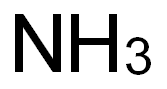
Ammonia solution , Concentration range: 0.812-3.30 (mg/L), analyze standard products , 7664-41-7
CAS NO.:7664-41-7
Empirical Formula: H3N
Molecular Weight: 17.03
MDL number: MFCD00011418
EINECS: 231-635-3
PRODUCT Properties
| Melting point: | −78 °C(lit.) |
| Boiling point: | 60 °C |
| Density | 1.023 g/mL at 25 °C |
| vapor density | 0.6 (vs air) |
| vapor pressure | 8.75 atm ( 21 °C) |
| FEMA | 4494 | AMMONIA (ALSO INCLUDES AMMONIUM CHLORIDE) |
| Flash point: | 52 °F |
| storage temp. | 0-6°C |
| solubility | Miscible with ethanol (95%) and water. |
| pka | 38(at 25℃) |
| form | Liquid |
| color | Colorless |
| Odor | Intense pungent odor detectable at 17 ppm |
| PH | pKa1= 9.461(25℃) |
| Odor Threshold | 1.5ppm |
| Odor Type | ammoniacal |
| explosive limit | 25% |
| Water Solubility | soluble |
| Thermal Conductivity | 0.025171 W/(m·K) |
| Specific Heat Capacity | Cp(gas): 2.06 J/(g·K), at 25℃ |
| Sensitive | Hygroscopic |
| Merck | 14,492 |
| BRN | 3587154 |
| Henry's Law Constant | 1.31 at 0 °C, 2.92 at 20 °C (droplet train apparatus, Shi et al., 1999) |
| Exposure limits | ACGIH:TLV-TWA 25 ppm (17 mg/m3); TLV-STEL 35 ppm (24 mg/m3) OSHA:PEL-TWA 50 ppm (35 mg/m3) NIOSH:REL-TWA 25 ppm; REL-STEL 35 ppm |
| Dielectric constant | 25.0(-59℃) |
| Stability: | Stable. Hygroscopic. Flammable. Incompatible with acids, strong oxidizing agents. May react violently with acids, aldehydes, alkylene oxides, amides, boron, boron halides, calcium, chlorine azide, chloric acid, chlorine monoxide, chlorites, halogens, heavy metals and many other materials - check the complete data sheet before use! |
| Cosmetics Ingredients Functions | BUFFERING FRAGRANCE |
| Cosmetic Ingredient Review (CIR) | Ammonia (7664-41-7) |
| InChI | 1S/H3N/h1H3 |
| InChIKey | QGZKDVFQNNGYKY-UHFFFAOYSA-N |
| SMILES | N |
| LogP | 0.23 at 20℃ |
| CAS DataBase Reference | 7664-41-7(CAS DataBase Reference) |
| NIST Chemistry Reference | Ammonia(7664-41-7) |
| EPA Substance Registry System | Ammonia (7664-41-7) |
Description and Uses
Ammonia is a colorless, pungent-smelling gas that is one of the most important industrial inorganic chemicals. It is widely used in fertilizers, refrigerants, explosives, cleaning agents, and as a feedstock to produce numerous other chemicals. Ammonia ranks as one of the top 10 chemicals produced annually.
NH3 (ammonia) is produced in the so-called Haber Bosch process. This industrial process uses finely
divided iron as catalyst and a reaction temperature of around 450 °C at a pressure of 50 atm. Ammonia is used
to produce fertilisers, nitric acid, nylon and many more products important to our modern life style.
N2(g) + 3H2(g) → 2NH3(g)
Safety
| Symbol(GHS) |     GHS02,GHS06,GHS08,GHS09 |
| Signal word | Danger |
| Hazard statements | H311+H331-H303-H315-H319-H360-H370-H372-H373-H334-H341-H335-H336-H411-H225 |
| Precautionary statements | P501-P273-P270-P202-P240-P260-P210-P233-P201-P243-P241-P242-P271-P264-P280-P284-P370+P378-P391-P342+P311-P337+P313-P305+P351+P338-P308+P311-P361+P364-P303+P361+P353-P332+P313-P304+P340+P311-P403+P233-P403+P235-P405 |
| target organs | Respiratory system |
| Hazard Codes | F,N,T,Xn |
| Risk Statements | 11-20-36/37/38-67-39/23/24/25-23/24/25-10-50-34-23-36-66-40-36/37-19 |
| Safety Statements | 26-7-45-36/37/39-16-9-61-36/37 |
| RIDADR | UN 1005 |
| OEB | A |
| OEL | TWA: 25 ppm (18 mg/m3), STEL: 35 ppm (27 mg/m3) |
| WGK Germany | 2 |
| RTECS | BO0875000 |
| Autoignition Temperature | 690 °C |
| TSCA | TSCA listed |
| DOT Classification | 2.2 (Non-flammable gas) |
| HazardClass | 2.3 |
| HS Code | 28141000 |
| Storage Class | 3 - Flammable liquids |
| Hazard Classifications | Carc. 1B Eye Irrit. 2 Flam. Liq. 2 STOT SE 3 |
| Hazardous Substances Data | 7664-41-7(Hazardous Substances Data) |
| Toxicity | LD50 oral (rat) 350 mg/kg LC50 inhal (rat) 2000 ppm (4 h) PEL (OSHA) 35 ppm (27 mg/m3) TLV-TWA (ACGIH) 25 ppm (17 mg/m3) STEL (ACGIH) 35 ppm (27 mg/m3) |
| IDLA | 300 ppm |
| REACH Registrations | Active |
| Limited Quantities | 1.0 L (0.3 gallon) (liquid) |
| Excepted Quantities | Max Inner Pack (30g or 30ml) and Max Outer Pack (500g or 500ml) |