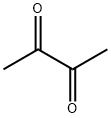
2,3-Butanedione , 98% , 431-03-8
Synonym(s):
2,3-Butanedione, 2,3-Butadione, Dimethyldiketon, Dimethylglyoxal;Biacetyl;Diacetyl
CAS NO.:431-03-8
Empirical Formula: C4H6O2
Molecular Weight: 86.09
MDL number: MFCD00008756
EINECS: 207-069-8
PRODUCT Properties
| Melting point: | -4--2 °C |
| Boiling point: | 88 °C(lit.) |
| Density | 0.985 g/mL at 20 °C |
| vapor density | 3 (vs air) |
| vapor pressure | 52.2 mm Hg ( 20 °C) |
| FEMA | 2370 | DIACETYL |
| refractive index | n |
| Flash point: | 45 °F |
| storage temp. | Store at +2°C to +8°C. |
| solubility | 200g/l |
| form | Liquid |
| color | Clear yellow |
| Odor | at 1.00 % in propylene glycol. strong butter sweet creamy pungent caramel |
| Odor Type | buttery |
| explosive limit | 2.4-13.0%(V) |
| Odor Threshold | 0.00005ppm |
| Water Solubility | 200 g/L (20 ºC) |
| Merck | 14,2966 |
| JECFA Number | 408 |
| BRN | 605398 |
| Henry's Law Constant | 7.3×10⁻¹ mol/(m3Pa) at 25℃, Burkholder et al. (2019) |
| Exposure limits | EU LTEL:0.02 ppm(0.07 mg/m3); EU STEL:0.1 ppm(0.36 mg/m3) |
| Stability: | Stable. Flammable. Incompatible with acids, strong bases, metals, reducing agents, oxidizing agents. Protect from moisture and water. Note low flashpoint. |
| Major Application | cleaning products cosmetics environmental flavors and fragrances food and beverages personal care |
| Cosmetics Ingredients Functions | PERFUMING |
| InChI | 1S/C4H6O2/c1-3(5)4(2)6/h1-2H3 |
| InChIKey | QSJXEFYPDANLFS-UHFFFAOYSA-N |
| SMILES | CC(=O)C(C)=O |
| LogP | -1.340 |
| CAS DataBase Reference | 431-03-8(CAS DataBase Reference) |
| NIST Chemistry Reference | 2,3-Butanedione(431-03-8) |
| EPA Substance Registry System | 2,3-Butanedione (431-03-8) |
Description and Uses
2,3-Butanedione, also known as Diacetyl, is a reactive diketone in artificial butter flavors. It is a water-soluble and volatile, alpha-diketone compound that has a buttery odor. Diacetyl occurs naturally in plants, fruits, coffee, honey, cocoa, and dairy products. It is a natural by-product of fermentation and is found in beer and wine. Diacetyl is also present in cigarette smoke.
Diacetyl can be synthesized by converting 2-butanone to an isonitroso compound and then hydrolyzing it with hydrochloric acid. Other methods for producing diacetyl include oxidation of 2-butanone over a copper catalyst at 300°C and dehydrogenation of 2,3-butanediol over a copper or silver catalyst. In addition, diacetyl can be synthesized through the acid catalyzed condensation of 1-hydroxyacetone and formaldehyde. Naturally occurring diacetyl is also available from starter distillate, a by-product of dairy product fermentation. Although diacetyl and starter distillates are liquids, they can be converted to a powdered form by encapsulating them within a solid material to prevent volatility. Diacetyl in powdered form is also found in flavorings that have been spray dried. The boiling point of diacetyl is 88°C with a calculated vapor pressure of 55 mmHg at 20°C.
2,3-Butanedione is a flavoring agent that is a clear yellow to yellowish green liquid with a strong pungent odor. It is chemically synthesized from methyl ethyl ketone. It is miscible in water, glycerin, alcohol, and ether, and in very dilute water solution it has a typical buttery odor and flavor. It is used as Carrier of aroma of butter, vinegar, coffee, and other foods. It is also used Inactivates aminopeptidase-N, precursor to α-diones, Cyclocondensation with amines has been used to form triazine and pteridine ring systems.
Safety
| Symbol(GHS) |     GHS02,GHS05,GHS06,GHS08 |
| Signal word | Danger |
| Hazard statements | H331-H302-H315-H318-H370-H372-H317-H351-H225 |
| Precautionary statements | P501-P272-P270-P202-P240-P260-P210-P233-P201-P243-P241-P242-P271-P264-P280-P370+P378-P308+P311-P362+P364-P303+P361+P353-P333+P313-P301+P312+P330-P304+P340+P311-P305+P351+P338+P310-P403+P233-P403+P235-P405 |
| target organs | Respiratory system |
| PPE | Eyeshields, Faceshields, Gloves, Heavyweight Gloves, Safety Clothing, type ABEK (EN14387) respirator filter |
| Hazard Codes | F,Xn |
| Risk Statements | 11-20/22-38-41-36/38-20/21/22-37/38 |
| Safety Statements | 9-16-26-37/39-36/37/39-39 |
| RIDADR | UN 2346 |
| WGK Germany | 2 |
| RTECS | EK2625000 |
| F | 13 |
| Autoignition Temperature | 365 °C |
| TSCA | TSCA listed |
| HazardClass | 3 |
| PackingGroup | II |
| HS Code | 29141990 |
| Storage Class | 3 - Flammable liquids |
| Hazard Classifications | Acute Tox. 3 Inhalation Acute Tox. 4 Oral Eye Dam. 1 Flam. Liq. 2 Skin Irrit. 2 Skin Sens. 1 STOT RE 2 Inhalation |
| Hazardous Substances Data | 431-03-8(Hazardous Substances Data) |
| Toxicity | LD50 orally in rats: 1580 mg/kg (Jenner) |
| REACH Registrations | Active |
| Limited Quantities | 1.0 L (0.3 gallon) (liquid) |
| Excepted Quantities | Max Inner Pack (30g or 30ml) and Max Outer Pack (500g or 500ml) |