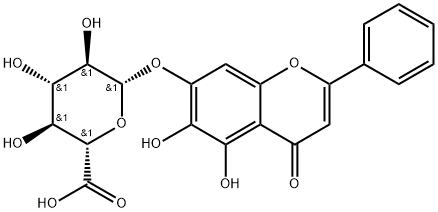
Baicalin , 95% , 21967-41-9
Synonym(s):
5,6-Dihydroxy-4-oxo-2-phenyl-4H-1-benzopyran-7-yl-β-D-glucopyranosiduronic acid;Baicalein 7-β-D -glucopyranosiduronate;Baicalein 7-O-β-D -glucuronide
CAS NO.:21967-41-9
Empirical Formula: C21H18O11
Molecular Weight: 446.36
MDL number: MFCD00149302
EINECS: 606-866-1
| Pack Size | Price | Stock | Quantity |
| 1G | RMB250.40 | In Stock |
|
| 5G | RMB1215.20 | In Stock |
|
| others | Enquire |
PRODUCT Properties
| Melting point: | 202-205 °C (dec.) (lit.) |
| alpha | -85 º (c=1, DMSO) |
| Boiling point: | 836.6±65.0 °C(Predicted) |
| Density | 1.737±0.06 g/cm3(Predicted) |
| storage temp. | 2-8°C |
| solubility | DMSO (Slightly), Methanol (Slightly) |
| form | solid |
| pka | 2.72±0.70(Predicted) |
| color | Pale Yellow to Yellow |
| optical activity | [α]20/D 85°, c = 1 in DMSO |
| Stability: | Hygroscopic |
| Cosmetics Ingredients Functions | SKIN CONDITIONING ANTIOXIDANT |
| InChIKey | IKIIZLYTISPENI-ZFORQUDYSA-N |
| SMILES | OC1C(=C(O[C@H]2[C@@H]([C@@H](O)[C@H](O)[C@@H](C(=O)O)O2)O)C=C2OC(C3C=CC=CC=3)=CC(=O)C=12)O |&1:5,6,7,9,11,r| |
| LogP | 1.431 (est) |
| CAS DataBase Reference | 21967-41-9(CAS DataBase Reference) |
Description and Uses
Baicalin is one of the main active ingredients obtained from the roots of huang qin (Scutellaria baicalensis Georgi). The Pharmacopoeia of the People’s Republic of China (2015) stipulates that the content of baicalin in radix scutellariae with dry goods shall not be less than 9.0%. The medicinal radix scutellariae distribution in China are now Yunnan radix scutellariae (S. amoena C.H. Wright), sticky hairs radix scutellariae (S. viscidula Bunge), Gansu radix scutellariae (S. rehderiana Diels), Lijiang radix scutellariae (S. likiangensis Diels), Sichuan radix scutellariae (S. hypericifolia Lev l.), radix scutellariae (S. tenax W.W. Smith var. patentipilosa G. Y. Wu), etc., which contain a certain amount of baicalin. Radix scutellariae medicinal has a long history in China. Listed as goods in Shen Nong’s Classic of Materia Medica, it has been used clinically to treat diseases with symptoms such as “heat jaundice, intestinal dysentery, edema, amenorrhea, malignant sore, and scleritis” for about 2000 years. Scutellaria is recorded in the Pharmacopoeia of the People’s Republic of China to have the effects of “clear heat and wet, purging fire to detoxify, stop bleeding and tocolysis.” It is one of the commonly used traditional Chinese herbs, which is clinically used alone or with other Chinese medicine compatibility for the treatment of respiratory infections, acute dysentery, viral hepatitis, allergic disease and gynecological disease, and so on.
diuretic, prolyl endopeptidase inhibitor, antineoplastic
Safety
| Symbol(GHS) |  GHS07 |
| Signal word | Warning |
| Hazard statements | H302 |
| Precautionary statements | P264-P270-P301+P312-P501 |
| PPE | dust mask type N95 (US), Eyeshields, Gloves |
| Hazard Codes | Xi |
| Risk Statements | 36/37/38 |
| Safety Statements | 26-36 |
| WGK Germany | 3 |
| RTECS | LZ5776910 |
| HS Code | 29329990 |
| Storage Class | 11 - Combustible Solids |
| Hazard Classifications | Acute Tox. 4 Oral |