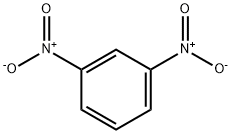
m-Dinitrobenzene , Used for HPLC derivative and detection steroids, ≥99.0%(HPLC) , 99-65-0
Synonym(s):
1,3-DNB
CAS NO.:99-65-0
Empirical Formula: C6H4N2O4
Molecular Weight: 168.11
MDL number: MFCD00007222
EINECS: 202-776-8
PRODUCT Properties
| Melting point: | 86 °C |
| Boiling point: | 297 °C(lit.) |
| Density | 1.575 |
| vapor pressure | 8.15 x 10⁻⁴ mmHg at 35 °C (Hine et al., 1963) |
| refractive index | 1.4660 (estimate) |
| Flash point: | 150 °C |
| storage temp. | 2-8°C |
| solubility | Chloroform (Sparingly), DMSO (Slightly), Methanol (Very Slightly) |
| form | solid |
| Specific Gravity | 1.368 |
| color | White to yellowish crystals |
| Water Solubility | 500 mg/L (20 ºC) |
| Specific Heat Capacity | Cp(crystal): 1.17 J/(g·K), at 25℃ |
| Merck | 14,3273 |
| BRN | 1105654 |
| Henry's Law Constant | 1.8×10² mol/(m3Pa) at 25℃, Chao et al. (2017) |
| Exposure limits | ACGIH:TLV-TWA 0.15 ppm (1 mg/m3),Inhalable fraction,and vapor OSHA:PEL-TWA 1 mg/m3 NIOSH:REL-TWA 1 mg/m3 |
| Dielectric constant | 2.8(20.0℃) |
| Stability: | Stable. Incompatible with reducing agents, oxidizing agents, strong bases. May explode if heated. |
| Major Application | environmental |
| InChI | 1S/C6H4N2O4/c9-7(10)5-2-1-3-6(4-5)8(11)12/h1-4H |
| InChIKey | WDCYWAQPCXBPJA-UHFFFAOYSA-N |
| SMILES | [O-][N+](=O)c1cccc(c1)[N+]([O-])=O |
| CAS DataBase Reference | 99-65-0(CAS DataBase Reference) |
| NIST Chemistry Reference | Benzene, 1,3-dinitro-(99-65-0) |
| EPA Substance Registry System | m-Dinitrobenzene (99-65-0) |
Description and Uses
1,3-Dinitrobenzene (1,3-DNB) is an impurity present in the manufacture of 2,4,6-trinitrotoluene. Workers in munitions plants are at risk of exposure. While it does not bioaccumulate, it persists in the environments (air, water, and soil) with slow rates of degradation. Metabolism in animals (rabbits) results in reduction of the nitro functionalities to amine functionalities to produce 2,4-diaminophenol, m-nitroaniline, m-phenylenediamine, and 2-amino-4-nitrophenol. Human exposure is generally dermal contact or inhalation of vapor.
1,3-Dinitrobenzene (1,3-DNB) is an impurity present in the manufacture of 2,4,6-trinitrotoluene. Dinitrobenzene (as a mixture of 1,2-dinitro- 1,3-dinitro- and 1,4-dinitro-isomers) is used in the manufacture of dyes and explosives, and in organic syntheses.
Safety
| Symbol(GHS) |    GHS06,GHS08,GHS09 |
| Signal word | Danger |
| Hazard statements | H300+H310+H330-H373-H410 |
| Precautionary statements | P262-P273-P280-P302+P352+P310-P304+P340+P310-P314 |
| PPE | dust mask type N95 (US), Eyeshields, Faceshields, Gloves, type P2 (EN 143) respirator cartridges |
| Hazard Codes | T+,N,T,F,Xn |
| Risk Statements | 26/27/28-33-50/53-40-36/37/38-23/24/25-11-52/53-36-20/21/22 |
| Safety Statements | 28-36/37-45-60-61-28A-27-16-26 |
| RIDADR | UN 3443 6.1/PG 2 |
| OEB | C |
| OEL | TWA: 1 mg/m3 [skin] |
| WGK Germany | 3 |
| RTECS | CZ7350000 |
| TSCA | TSCA listed |
| HazardClass | 6.1 |
| PackingGroup | II |
| HS Code | 29042090 |
| Storage Class | 6.1A - Combustible acute toxic Cat. 1 and 2 very toxic hazardous materials |
| Hazard Classifications | Acute Tox. 1 Dermal Acute Tox. 2 Inhalation Acute Tox. 2 Oral Aquatic Acute 1 Aquatic Chronic 1 STOT RE 2 |
| Hazardous Substances Data | 99-65-0(Hazardous Substances Data) |
| Toxicity | LD50 in male, female rats (mg/kg): 91, 81 orally (Cody) |
| Limited Quantities | 0.5 Kg (solid) |
| Excepted Quantities | Max Inner Pack (1g or 1ml) and Max Outer Pack (500g or 500ml) |