PRODUCT Properties
| Melting point: | 127-129 C |
| alpha | D25 +8.7° (c = 2 in H2O); D15 +21.2° (c = 18) |
| Boiling point: | bp17 127-129°; bp10 123-126° |
| Density | 1.272±0.06 g/cm3(Predicted) |
| refractive index | n20/D 1.494 |
| Flash point: | 112 °C |
| storage temp. | 2-8°C |
| solubility | DMSO, Methanol (Slightly), Water (Slightly) |
| pka | 12.60±0.20(Predicted) |
| form | liquid (viscous) |
| color | Clear Colourless to Light Brown |
| optical activity | +8.7 |
| Merck | 13,4494 |
| BRN | 1720474 |
| InChI | 1S/C3H6O3/c4-1-3(6)2-5/h1,3,5-6H,2H2/t3-/m0/s1 |
| InChIKey | MNQZXJOMYWMBOU-VKHMYHEASA-N |
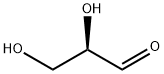
| SMILES | OC[C@@H](O)C=O |
| CAS DataBase Reference | 453-17-8(CAS DataBase Reference) |
| NIST Chemistry Reference | Propanal, 2,3-dihydroxy-, (r)-(453-17-8) |
Description and Uses
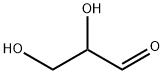
D-(+)-Glyceraldehyde is an intermediate in carbohydrate metabolism. It is phosphorylated by triose kinase to produce D-glyceraldehyde 3-phosphate, an intermediate in glycolysis, gluconeogenesis, photosynthesis, and other metabolic pathways.
D-(+)-Glyceraldehyde can be utilized as a reactant in the synthesis of:
- (S)-homophenylalanine by ruthenium oxidation of a 3-amino-1,2-diol generated via coupling of an amine, and α-hydroxyaldehyde.
- β- and γ-allenols via metal-catalyzed cyclization. Allenols are used as a key precursor for the preparation of enantiopure dihydropyrans and tetrahydrooxepines.
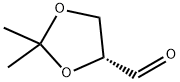
- Isopropylidene D-glyceraldehyde intermediate, which controls the chirality in the total synthesis of prostaglandins (PGE1).
Safety
| PPE | Eyeshields, Gloves |
| Hazard Codes | Xi |
| Risk Statements | 36/37/38 |
| Safety Statements | 26-27-36/37/39 |
| WGK Germany | 3 |
| F | 10-23 |
| Storage Class | 10 - Combustible liquids |