A4297512
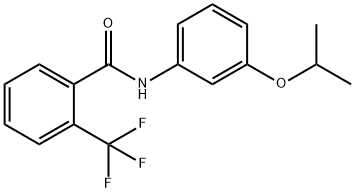
Flutolanil , Analysis standard , 66332-96-5
Synonym(s):
N-(3-Isopropoxyphenyl)-2-(trifluoromethyl)benzamide
| Pack Size | Price | Stock | Quantity |
| 100MG | RMB398.40 | In Stock |
|
| others | Enquire |
Update time: 2022-07-08
PRODUCT Properties
| Melting point: | 108° (Araki, Yabutani); mp 104-105° (Araki, 1985) |
| Boiling point: | 339.1±42.0 °C(Predicted) |
| Density | 1.2463 (estimate) |
| vapor pressure | 6.5 x 10⁻⁶ Pa (25 °C) |
| storage temp. | 0-6°C |
| solubility | Chloroform (Slightly), Methanol (Slightly) |
| form | Solid |
| Water Solubility | 6.53 mg l-1 (20 °C) |
| pka | 12.44±0.70(Predicted) |
| color | White to Pale Orange |
| Henry's Law Constant | 3.1×10³ mol/(m3Pa) at 25℃, Duchowicz et al. (2020) |
| InChI | InChI=1S/C17H16F3NO2/c1-11(2)23-13-7-5-6-12(10-13)21-16(22)14-8-3-4-9-15(14)17(18,19)20/h3-11H,1-2H3,(H,21,22) |
| InChIKey | PTCGDEVVHUXTMP-UHFFFAOYSA-N |
| SMILES | C(NC1=CC=CC(OC(C)C)=C1)(=O)C1=CC=CC=C1C(F)(F)F |
| LogP | 3.700 |
| EPA Substance Registry System | Flutolanil (66332-96-5) |
Description and Uses
Flutolanil is a systemic fungicide. It has a low aqueous solubility, volatile with a marginal risk of leaching to groundwater. It is persistent in both soils and aquatic systems. Although it has a low mammalian toxicity it does show some potential to bioaccumulate. No serious risks to human health have been identified. It is moderately toxic to birds and most aquatic organisms and earthworms but has a low toxicity to honeybees.
Flutolanil is a fungicide that has been used for controlling brown patch on creeping bentgrass fairways.
Safety
| Symbol(GHS) |  GHS09 |
| Signal word | Warning |
| Hazard statements | H410 |
| Precautionary statements | P273-P391-P501 |
| WGK Germany | WGK 2 |
| RTECS | CV5581320 |
| Storage Class | 11 - Combustible Solids |
| Hazard Classifications | Aquatic Acute 1 Aquatic Chronic 1 |
| Hazardous Substances Data | 66332-96-5(Hazardous Substances Data) |
| Toxicity | LD50 in male and female rats, male and female mice (mg/kg): >10,000, >10,000 orally; in male and female rats (mg/kg): >5000 dermally (Araki) |