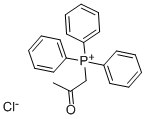
A5363612
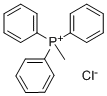
Methyltriphenylphosphonium chloride , 97% , 1031-15-8
CAS NO.:1031-15-8
Empirical Formula: C19H18ClP
Molecular Weight: 312.77
MDL number: MFCD00797851
EINECS: 418-400-2
| Pack Size | Price | Stock | Quantity |
| 1G | RMB23.20 | In Stock |
|
| 5G | RMB39.20 | In Stock |
|
| 25G | RMB55.20 | In Stock |
|
| 100G | RMB201.60 | In Stock |
|
| 500g | RMB988.00 | In Stock |
|
| others | Enquire |
Update time: 2022-07-08
PRODUCT Properties
| Melting point: | 221°C (dec.) |
| Boiling point: | 332.65℃ at 101.3kPa |
| Density | 1.22 at 23℃ |
| vapor pressure | 0.001Pa at 40℃ |
| storage temp. | Inert atmosphere,Room Temperature |
| solubility | Soluble in methanol. |
| form | Solid:crystalline |
| color | White to Almost white |
| Sensitive | Hygroscopic |
| InChI | 1S/C19H18P.ClH/c1-20(17-11-5-2-6-12-17,18-13-7-3-8-14-18)19-15-9-4-10-16-19;/h2-16H,1H3;1H/q+1;/p-1 |
| InChIKey | QRPRIOOKPZSVFN-UHFFFAOYSA-M |
| SMILES | [Cl-].C[P+](c1ccccc1)(c2ccccc2)c3ccccc3 |
| LogP | -1.73 at 20℃ and pH6.3-6.46 |
| Surface tension | 71.4mN/m at 1g/L and 20℃ |
| CAS DataBase Reference | 1031-15-8(CAS DataBase Reference) |
Description and Uses
Methyltriphenylphosphonium chloride is used as a phase transfer catalyst in synthetic chemistry. It acts as a catalyst for regio-controlled ring-opening polymerization of substituted epoxides. It is utilized for controlling the corrosion iron. It acts as a reactant for intramolecular nitrone cycloaddition. In addition to this, it is used for neoplasm inhibition through antimitochondrial effect.
Safety
| Symbol(GHS) |    GHS05,GHS06,GHS09 |
| Signal word | Danger |
| Hazard statements | H301-H312-H315-H318-H411 |
| Precautionary statements | P264-P273-P280-P301+P310-P302+P352+P312-P305+P351+P338 |
| PPE | dust mask type N95 (US), Eyeshields, Gloves |
| Hazard Codes | Xn;N,N,Xn |
| Risk Statements | 21/22-38-41-51/53 |
| Safety Statements | 22-26-36/37/39-61 |
| RIDADR | UN 3077 |
| WGK Germany | 2 |
| HazardClass | 9 |
| PackingGroup | III |
| HS Code | 29319090 |
| Storage Class | 6.1C - Combustible acute toxic Cat.3 toxic compounds or compounds which causing chronic effects |
| Hazard Classifications | Acute Tox. 3 Oral Acute Tox. 4 Dermal Aquatic Chronic 2 Eye Dam. 1 Skin Irrit. 2 |
| REACH Registrations | Active |