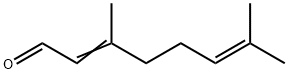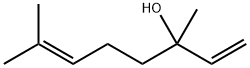
Linalool , 10mMinDMSO , 78-70-6
Synonym(s):
(±)-3,7-Dimethyl-1,6-octadien-3-ol;(±)-3,7-Dimethyl-3-hydroxy-1,6-octadiene;3,7-Dimethyl-1,6-octadien-3-ol;Linalool
CAS NO.:78-70-6
Empirical Formula: C10H18O
Molecular Weight: 154.25
MDL number: MFCD00008906
EINECS: 201-134-4
| Pack Size | Price | Stock | Quantity |
| 1ml | RMB159.20 | In Stock |
|
| others | Enquire |
PRODUCT Properties
| Melting point: | 25°C |
| Boiling point: | 194-197 °C/720 mmHg (lit.) |
| Density | 0.87 g/mL at 25 °C (lit.) |
| vapor pressure | 0.17 mm Hg ( 25 °C) |
| refractive index | n |
| FEMA | 2635 | LINALOOL |
| Flash point: | 174 °F |
| storage temp. | 2-8°C |
| solubility | ethanol: soluble1ml/4ml, clear, colorless (60% ethanol) |
| form | Liquid |
| pka | 14.51±0.29(Predicted) |
| Specific Gravity | 0.860 (20/4℃) |
| color | Clear colorless to pale yellow |
| PH | 4.5 (1.45g/l, H2O, 25℃) |
| Odor | at 100.00 %. citrus floral sweet bois de rose woody green blueberry |
| Odor Type | floral |
| biological source | synthetic |
| explosive limit | 0.9-5.2%(V) |
| Water Solubility | 1.45 g/L (25 ºC) |
| Merck | 14,5495 |
| JECFA Number | 356 |
| BRN | 1721488 |
| Henry's Law Constant | 2.0×10⁻¹ mol/(m3Pa) at 25℃, Leng et al. (2013) |
| Stability: | Stable. Incompatible with strong oxidizing agents. Combustible. |
| Cosmetics Ingredients Functions | DEODORANT PERFUMING |
| InChI | 1S/C10H18O/c1-5-10(4,11)8-6-7-9(2)3/h5,7,11H,1,6,8H2,2-4H3 |
| InChIKey | CDOSHBSSFJOMGT-UHFFFAOYSA-N |
| SMILES | C\C(C)=C\CCC(C)(O)C=C |
| LogP | 2.9 at 20℃ |
| CAS DataBase Reference | 78-70-6(CAS DataBase Reference) |
| NIST Chemistry Reference | 2,6-Dimethylocta-2,7-dien-6-ol(78-70-6) |
| EPA Substance Registry System | 3,7-Dimethyl-1,6-octadien-3-ol (78-70-6) |
Description and Uses
Linalool has a typical floral odor free from camphoraceous and
terpenic notes.1 Synthetic linalool exhibits a cleaner and fresher
note than the natural product. It can be prepared synthetically
starting from myrcene or from dehydrolinalool.
The optically active forms (d- and ι-) and the optically inactive
form occur naturally in more than 2 0 0 oils from herbs, leaves,
flowers, and wood; the ι-form is present in the largest amounts
(80 - 85%) in the distillates from leaves of Cinnamomum cam phora var. orientalis and Cinnamomum camphora var. occidentalis
and in the distillate from Cajenne rosewood; it also has been
reported in: champaca, ylang-ylang, neroli, Mexican linaloe, ber gamot, lavandin, and others; a mixture of d- and ι-linalool has
been reported in Brazil rosewood (85%); the d-form has been
found in palmarosa, mace, sweet orange-flower distillate, petit grain, coriander (60 - 70%), marjoram, Orthodon linalooliferum
(80%), and others; the inactive form has been reported in clary
sage, jasmine, and Nectandra elaiophora.
Linalool is one of the allergens of Ylang-Ylang oil (extract from Cananga odorata).
Safety
| Symbol(GHS) |  GHS07 |
| Signal word | Warning |
| Hazard statements | H315-H317-H319 |
| Precautionary statements | P261-P264-P272-P280-P302+P352-P305+P351+P338 |
| PPE | Eyeshields, Gloves, type ABEK (EN14387) respirator filter |
| Hazard Codes | Xi,Xn |
| Risk Statements | 36/37/38-20/21/22 |
| Safety Statements | 26-36 |
| RIDADR | NA 1993 / PGIII |
| WGK Germany | 1 |
| RTECS | RG5775000 |
| Autoignition Temperature | 235 °C |
| TSCA | TSCA listed |
| HazardClass | 3 |
| HS Code | 29052210 |
| Storage Class | 10 - Combustible liquids |
| Hazard Classifications | Eye Irrit. 2 Skin Irrit. 2 Skin Sens. 1 |
| Hazardous Substances Data | 78-70-6(Hazardous Substances Data) |
| Toxicity | LD50 orally in Rabbit: 2790 mg/kg LD50 dermal Rabbit 5610 mg/kg |
| REACH Registrations | Active |
| Limited Quantities | 5.0 L (1.3 gallons) (liquid) |
| Excepted Quantities | Max Inner Pack (30g or 30ml) and Max Outer Pack (1Kg or 1L) |