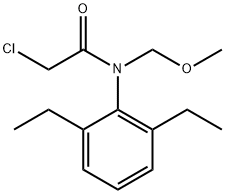
A8332332
Alachlor solution , analyticalstandard,100mg/Linmethanol , 15972-60-8
Synonym(s):
2-Chloro-2′,6′-diethyl-N-(methoxymethyl)acetanilide
CAS NO.:15972-60-8
Empirical Formula: C14H20ClNO2
Molecular Weight: 269.77
MDL number: MFCD00041817
EINECS: 240-110-8
Update time: 2022-07-08
PRODUCT Properties
| Melting point: | 39-42°C |
| Boiling point: | 100°C (0.02 mmHg) |
| Density | d2515.6 1.133 |
| refractive index | 1.5388 (estimate) |
| Flash point: | -18 °C |
| storage temp. | 2-8°C |
| solubility | DMF: 30 mg/ml,DMSO: 30 mg/ml |
| pka | 1.20±0.50(Predicted) |
| Water Solubility | 0.024 g/100 mL |
| Merck | 13,201 |
| BRN | 2944476 |
| Henry's Law Constant | 6.7×10² mol/(m3Pa) at 25℃, Muir et al. (2004) |
| Major Application | agriculture cleaning products cosmetics environmental food and beverages personal care |
| InChI | 1S/C14H20ClNO2/c1-4-11-7-6-8-12(5-2)14(11)16(10-18-3)13(17)9-15/h6-8H,4-5,9-10H2,1-3H3 |
| InChIKey | XCSGPAVHZFQHGE-UHFFFAOYSA-N |
| SMILES | CCc1cccc(CC)c1N(COC)C(=O)CCl |
| CAS DataBase Reference | 15972-60-8(CAS DataBase Reference) |
| NIST Chemistry Reference | Alachlor(15972-60-8) |
| EPA Substance Registry System | Alachlor (15972-60-8) |
Description and Uses
Alachlor is a herbicide. Occupational contact dermatitis was rarely observed in agricultural workers.
Alachlor is used pre- or early post-emergence to control annual grasses and many broadleaved weeds mainly in maize, but also in cotton, brassicas, oilseed rape, peanuts, radish, soy beans, and sugar-cane.
Safety
| Symbol(GHS) |    GHS07,GHS08,GHS09 |
| Signal word | Warning |
| Hazard statements | H302-H317-H351-H410 |
| Precautionary statements | P264-P270-P261-P272-P280-P201-P202-P273-P301+P312-P330-P302+P352-P333+P313-P362+P364-P308+P313-P391-P405-P501 |
| PPE | Eyeshields, Faceshields, Gloves, type P3 (EN 143) respirator cartridges |
| Hazard Codes | Xn;N,N,Xn,F,T |
| Risk Statements | 22-40-43-50/53-67-65-38-11-52/53-39/23/24/25-23/24/25-51/53 |
| Safety Statements | 36/37-46-60-61-62-45-16 |
| RIDADR | UN 3077 |
| WGK Germany | 3 |
| RTECS | AE1225000 |
| HazardClass | 9 |
| PackingGroup | III |
| Storage Class | 11 - Combustible Solids |
| Hazard Classifications | Acute Tox. 4 Oral Aquatic Acute 1 Aquatic Chronic 1 Carc. 2 Skin Sens. 1 |
| Hazardous Substances Data | 15972-60-8(Hazardous Substances Data) |
| Toxicity | LD50 orally in rats: 1200 mg/kg (Evans) |