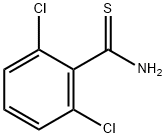
2,6-Dichlorothiobenzamide , 97 , 1918-13-4
Synonym(s):
2,6-Dichlorobenzenecarbothioamide;2,6-Dichlorothiobenzamide
CAS NO.:1918-13-4
Empirical Formula: C7H5Cl2NS
Molecular Weight: 206.09
MDL number: MFCD00053523
EINECS: 217-637-7
| Pack Size | Price | Stock | Quantity |
| 250mg | RMB680.00 | In Stock |
|
| 1g | RMB1699.20 | In Stock |
|
| 5g | RMB5240.00 | In Stock |
|
| others | Enquire |
PRODUCT Properties
| Melting point: | 151-152°C |
| Boiling point: | 320.6±52.0 °C(Predicted) |
| Density | 1.4704 (rough estimate) |
| refractive index | 1.6300 (estimate) |
| Flash point: | >100 °C |
| storage temp. | -20°C Freezer, Under inert atmosphere |
| solubility | DMSO (Slightly), Methanol (Slightly) |
| pka | 11.71±0.29(Predicted) |
| color | White to Pale Beige |
| Water Solubility | 0.95g/L(21 ºC) |
| BRN | 1910353 |
| Henry's Law Constant | 3.5×10⁴ mol/(m3Pa) at 25℃, MacBean (2012) |
| CAS DataBase Reference | 1918-13-4(CAS DataBase Reference) |
| EPA Substance Registry System | Chlorthiamid (1918-13-4) |
Description and Uses
Chlorthiamid is an obsolete pre-emergence herbicide once used for non-selective weed control. It is moderate soluble in water and is non-volatile. It is not persistent in soil systems and considered to be moderately mobile, and so it may leach to groundwater under certain conditions. Its toxicity to flora and fauma tends to be low to moderate. It also has a low mammalian toxicity. Little information is available on chlorthiamids potential for serious adverse health effects.
Refer to the productμs Certificate of Analysis for more information on a suitable instrument technique. Contact Technical Service for further support.