LN-817129
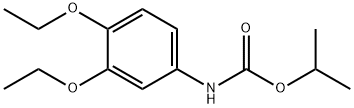
Diethofencarb , 0.99 , 87130-20-9
Synonym(s):
Isopropyl N-(3,4-diethoxyphenyl)carbamate
Update time: 2023-04-23
PRODUCT Properties
| Melting point: | 101.3° |
| Boiling point: | 325.9±32.0 °C(Predicted) |
| Density | 1.098±0.06 g/cm3(Predicted) |
| vapor pressure | 8.4 x 10⁻³ Pa (20 °C) |
| storage temp. | 2-8°C |
| solubility | Chloroform (Slightly), Ethyl Acetate (Slightly) |
| Water Solubility | 26.6 mg l-1 (20 °C) |
| pka | 12.75±0.70(Predicted) |
| color | Pale Pink to Light Pink |
| Henry's Law Constant | 1.2×101 mol/(m3Pa) at 25℃, Duchowicz et al. (2020) |
| Major Application | agriculture environmental |
| InChI | InChI=1S/C14H21NO4/c1-5-17-12-8-7-11(9-13(12)18-6-2)15-14(16)19-10(3)4/h7-10H,5-6H2,1-4H3,(H,15,16) |
| InChIKey | LNJNFVJKDJYTEU-UHFFFAOYSA-N |
| SMILES | C(OC(C)C)(=O)NC1=CC=C(OCC)C(OCC)=C1 |
| LogP | 2.910 |
| CAS DataBase Reference | 87130-20-9(CAS DataBase Reference) |
| EPA Substance Registry System | Carbamic acid, N-(3,4-diethoxyphenyl)-, 1-methylethyl ester (87130-20-9) |
Description and Uses
Diethofencarb is a carbamate fungicide. It has a moderate aqueous solubility and is volatile. Based on its chemical properties, it is not expected to leach to groundwater. It is not persistent in soils but can be in water in some circumstances. It has a low mammalian toxicity. However, exposure may damage reproduction and/or development. Diethofencarb is also a recognised irritant. It is moderately toxic to most aquatic organisms, honeybees and earthworms.
Agricultural fungicide.
Safety
| Symbol(GHS) |  GHS07 |
| Signal word | Warning |
| Hazard statements | H319 |
| Precautionary statements | P305+P351+P338 |
| PPE | dust mask type N95 (US), Eyeshields, Gloves |
| Hazard Codes | Xi |
| Risk Statements | 36 |
| Safety Statements | 26 |
| WGK Germany | 2 |
| RTECS | EZ4215700 |
| Storage Class | 11 - Combustible Solids |
| Hazard Classifications | Eye Irrit. 2 |
| Toxicity | LD50 in male and female rats (mg/kg): >5000, >5000 orally; >5000, >5000 dermally; LC50 (48 hrs) in carp: 13.5 mg/l; (3 hrs) in Daphnia pulex: >10 mg/l (Fujimura, review) |
| REACH Registrations | Inactive |