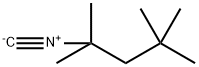
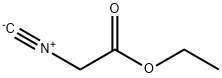
8016-36-2
Synonym(s):
Olibanum oil;Frankincense;FRE;FRITZ;FRP-3
CAS NO.:8016-36-2
Empirical Formula: C63H98O6
Molecular Weight:
MDL number: MFCD00217616
EINECS: 232-482-5
PRODUCT Properties
| Boiling point: | 140 °C(lit.) |
| Density | 0.870 g/mL at 25 °C(lit.) |
| FEMA | 2816 | OLIBANUM OIL (BOSWELLIA SPP.) |
| refractive index | n |
| Flash point: | 47 °C |
| storage temp. | -20°C |
| form | buffered aqueous solution |
| Odor | at 10.00 % in dipropylene glycol. terpenic incense peppery spicy old wood woody pine resinous |
| Odor Type | terpenic |
| biological source | mouse |
| optical activity | [α]/D 17.0 to 10.0° (neat) |
| Cosmetics Ingredients Functions | SKIN CONDITIONING HAIR CONDITIONING PERFUMING NAIL CONDITIONING |
| EPA Substance Registry System | Olibanum oil (8016-36-2) |
Description and Uses
Olibanum is a gum resin secreted by several Boswellia species that grow extensively from South Arabia to Somaliland. The small trees or shrubs yield an exudate after incisions are made on the bark; it consists of a milky liquid that hardens into small, yellowish droplets commercially known as incense tears. The tears are sorted; the most valuable quality (white tears) is sold as burning incense, while the less valuable qualities (powder and fragments) are used in flavors and perfumes because of their more reasonable cost. The part used is the gum resin exudate.
olibanum oil is a fragrance component. It is astringent with slight anti-inflammatory properties.
Safety
| Symbol(GHS) |  GHS02 |
| Signal word | Warning |
| Hazard statements | H226 |
| Precautionary statements | P264-P280-P302+P352-P321-P332+P313-P362-P261-P272-P280-P302+P352-P333+P313-P321-P363-P501 |
| Risk Statements | 10 |
| Safety Statements | 16 |
| RIDADR | UN 1993 3/PG 3 |
| WGK Germany | 3 |
| TSCA | TSCA listed |
| Storage Class | 10 - Combustible liquids |