
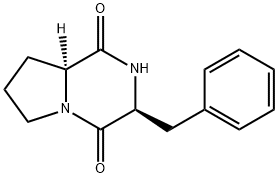
PRODUCT Properties
| Melting point: | 146-148 °C |
| Boiling point: | 509.5±39.0 °C(Predicted) |
| Density | 1.26±0.1 g/cm3(Predicted) |
| storage temp. | -15°C |
| solubility | Chloroform (Slightly), Ethanol (Slightly, Sonicated) |
| form | Solid |
| pka | 13.21±0.40(Predicted) |
| color | White to Off-White |
| Stability: | Hygroscopic |
| InChI | 1S/C14H16N2O2/c17-13-12-7-4-8-16(12)14(18)11(15-13)9-10-5-2-1-3-6-10/h1-3,5-6,11-12H,4,7-9H2,(H,15,17)/t11-,12-/m0/s1 |
| InChIKey | QZBUWPVZSXDWSB-RYUDHWBXSA-N |
| SMILES | N21[C@@H](CCC2)C(=O)N[C@H](C1=O)Cc3ccccc3 |
Description and Uses
Cyclo(L-Phe-L-Pro) is a diketopiperazine formed by the fusion of phenylalanine and proline, reported as a secondary metabolite of fungi and bacteria. In Pseudomonas aeruginosa, cyclo(L-Phe-L-Pro) is capable of activating N-acylhomoserine lactones (AHLs). Cyclo(L-Phe-L-Pro) is also capable of activating or antagonizing other LuxR-based quorum-sensing systems. While the mode of action of cyclo(L-Phe-L-Pro) is not known, its activity suggests the existence of cross talk among bacterial signalling systems.
Safety
| WGK Germany | WGK 3 |
| Storage Class | 11 - Combustible Solids |
![(3S,8aS)-3-Isopropylhexahydropyrrolo[1,2-a]pyrazine-1,4-dione](https://img.chemicalbook.com/CAS/20180906/GIF/2854-40-2.gif)
![(S,S)-3-Benzyl-1,4-diazabicyclo[4.3.0]nonane](https://img.chemicalbook.com/CAS/GIF/816429-58-0.gif)