PRODUCT Properties
| Melting point: | 200 °C |
| Boiling point: | 480.3±45.0 °C(Predicted) |
| Density | 1.371±0.06 g/cm3(Predicted) |
| solubility | soluble in Dimethylformamide |
| form | powder to crystal |
| pka | 8.65±0.40(Predicted) |
| Colour Index | 37550 |
| color | White to Amber |
| InChI | InChI=1S/C19H16ClNO4/c1-24-17-10-18(25-2)15(9-14(17)20)21-19(23)13-7-11-5-3-4-6-12(11)8-16(13)22/h3-10,22H,1-2H3,(H,21,23) |
| InChIKey | XDWATWCCUTYUDE-UHFFFAOYSA-N |
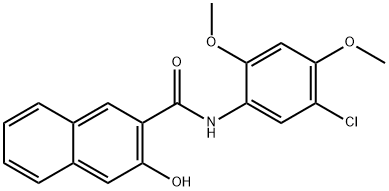
| SMILES | C1=C2C(C=CC=C2)=CC(O)=C1C(NC1=CC(Cl)=C(OC)C=C1OC)=O |
| CAS DataBase Reference | 92-72-8(CAS DataBase Reference) |
| NIST Chemistry Reference | 2-Naphthalenecarboxamide, n-(5-chloro-2,4-dimethoxyphenyl)-3-hydroxy-(92-72-8) |
| EPA Substance Registry System | 2-Naphthalenecarboxamide, N-(5-chloro-2,4-dimethoxyphenyl)-3-hydroxy- (92-72-8) |
Description and Uses
N-(2-Hydroxynaphthoyl)-2,4-dimethoxy-5-chloroanilide is mainly used as a base dye for cotton, dyeing it red. When combined with red-based ITR and red-based KL, it can produce a vibrant pink color, exhibiting high affinity for cotton. It is also used for dyeing viscose fibers, silk, and nylon, as well as for printing on cotton fabrics and for manufacturing lake pigments; it can also be used in the manufacture of organic pigments.
Safety
| Symbol(GHS) |    GHS07,GHS08,GHS09 |
| Signal word | Danger |
| Hazard statements | H302-H315-H317-H319-H335-H400-H372 |
| Precautionary statements | P261-P273-P280-P305+P351+P338 |
| TSCA | TSCA listed |
| HS Code | 2924.29.7790 |
| REACH Registrations | Active |