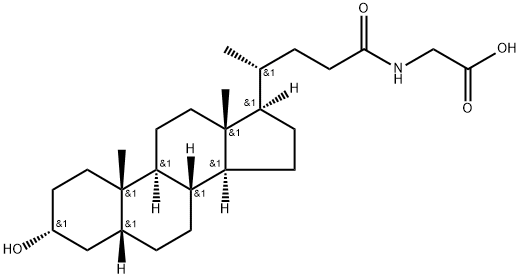
PRODUCT Properties
| Melting point: | 212-214 °C |
| Boiling point: | 546.95°C (rough estimate) |
| Density | 1.0738 (rough estimate) |
| refractive index | 1.6000 (estimate) |
| storage temp. | Refrigerator |
| solubility | Chloroform (Slightly, Heated), Methanol (Slightly, Heated) |
| form | Solid |
| pka | 3.58±0.10(Predicted) |
| color | White to Off-White |
| InChIKey | XBSQTYHEGZTYJE-LNYAHCOINA-N |
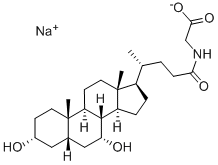
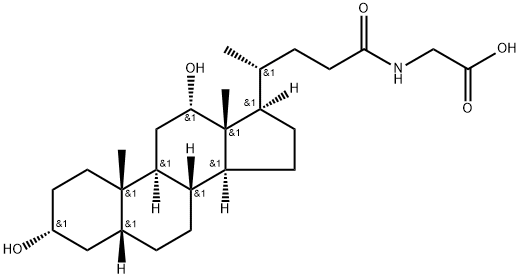
| SMILES | C[C@]12CC[C@]3([H])[C@]4(CC[C@@H](O)C[C@@]4([H])CC[C@@]3([H])[C@]1([H])CC[C@]2([H])[C@H](C)CCC(=O)NCC(=O)O)C |&1:1,4,6,9,12,16,18,22,24,r| |
Description and Uses
Glycolithocholic acid is a glycine-conjugated form of the secondary bile acid lithocholic acid . It is increased in the liver of mice fed a diet supplemented with ursodeoxycholic acid . Glycolithocholic acid levels are decreased in the plasma following subcutaneous administration of PEG-obestatin(Cys10, Cys13), a modified peptide hormone, in lean or diet-induced obese mice. Serum glycolithocholic acid levels increase with age in children.
A metabolite in human hepatic bile. A lithocholic acid analog that inhibit sialyltransferase.
Safety
| Symbol(GHS) |   GHS02,GHS08 |
| Signal word | Danger |
| WGK Germany | WGK 3 |
| Storage Class | 11 - Combustible Solids |