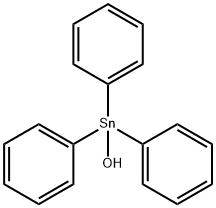
Triphenyltinhydroxide , 76-87-9
Synonym(s):
Triphenyltin hydroxide;Fentin hydroxide;Hydroxytriphenylstannane;K19;Keratin type I cytoskeletal 19
CAS NO.:76-87-9
Empirical Formula: C18H16OSn
Molecular Weight: 367.03
MDL number: MFCD00013928
EINECS: 200-990-6
PRODUCT Properties
| Melting point: | 124-126 °C (lit.) |
| Boiling point: | 428.5±28.0 °C(Predicted) |
| Density | 1.54 |
| storage temp. | -20°C |
| solubility | Slightly soluble in alcohol, toluene |
| pka | 3.98±0.70(Predicted) |
| form | Powder |
| color | Off-white |
| biological source | rabbit |
| Water Solubility | <0.1 g/100 mL at 21 ºC |
| Merck | 14,9745 |
| BRN | 4139186 |
| Henry's Law Constant | 2.3×101 mol/(m3Pa) at 25℃, Duchowicz et al. (2020) |
| Exposure limits | ACGIH: TWA 0.1 mg/m3; STEL 0.2 mg/m3 (Skin) NIOSH: IDLH 25 mg/m3; TWA 0.1 mg/m3 |
| Major Application | agriculture cleaning products cosmetics environmental food and beverages personal care |
| InChI | 1S/3C6H5.H2O.Sn/c3*1-2-4-6-5-3-1;;/h3*1-5H;1H2;/q;;;;+1/p-1 |
| InChIKey | BFWMWWXRWVJXSE-UHFFFAOYSA-M |
| SMILES | O[Sn](c1ccccc1)(c2ccccc2)c3ccccc3 |
| CAS DataBase Reference | 76-87-9(CAS DataBase Reference) |
| NIST Chemistry Reference | Stannane, hydroxytriphenyl-(76-87-9) |
| EPA Substance Registry System | Triphenyltin hydroxide (76-87-9) |
Description and Uses
Fentin hydroxide is an obsolete organotin fungicide. It has a low aqueous solubility and low volatility. Evidence suggests it is not persistent in soil systems but may be more so in aquatic systems. Based on its physico-chemical properties it is not expected to leach to groundwater. Ecotoxicological data is limited but acute oral ecotoxicity tends to be high to moderate. It is moderately toxic to mammals via the oral route.
Reactant involved in transmetalation reactions with Ir clusters. Reactant involved in synthesis of (E)-(Nitrophenyl)propenoic acid organotin(IV) carboxylates with antitumor activity, triorganotin chrysanthemumates for larvicidal studies, polynuclear organotin(IV) carboxylates containing ferrocenyl moieties for antitumor investigation, organotin(IV) aminophenylacrylate complexes, 4-Biphenylcarboxylic acid derivatives for in vitro cytotoxicity studies.
Safety
| Symbol(GHS) |     GHS05,GHS06,GHS08,GHS09 |
| Signal word | Danger |
| Hazard statements | H301-H311-H315-H318-H330-H335-H351-H372-H410 |
| Precautionary statements | P264-P270-P280-P260-P271-P284-P261-P201-P202-P273-P301+P310-P330-P302+P352-P312-P361+P364-P332+P313-P362+P364-P305+P351+P338-P310-P304+P340-P308+P313-P314-P391-P405-P403+P233-P501 |
| target organs | Respiratory system |
| PPE | dust mask type N95 (US), Eyeshields, Faceshields, Gloves, type P2 (EN 143) respirator cartridges |
| Hazard Codes | T+,N |
| Risk Statements | 24/25-26-37/38-40-41-48/23-50/53-63-36/37/38 |
| Safety Statements | 26-28-36/37/39-45-60-61 |
| RIDADR | UN 3146 6.1/PG 2 |
| WGK Germany | 3 |
| RTECS | WH8575000 |
| TSCA | TSCA listed |
| HazardClass | 6.1 |
| PackingGroup | III |
| HS Code | 29319090 |
| Storage Class | 6.1A - Combustible acute toxic Cat. 1 and 2 very toxic hazardous materials |
| Hazard Classifications | Acute Tox. 2 Inhalation Acute Tox. 2 Oral Acute Tox. 3 Dermal Aquatic Acute 1 Aquatic Chronic 1 Carc. 2 Eye Dam. 1 Repr. 2 Skin Irrit. 2 STOT RE 1 STOT SE 2 STOT SE 3 |
| Hazardous Substances Data | 76-87-9(Hazardous Substances Data) |
| Toxicity | LD50 oral in rat: 46mg/kg |