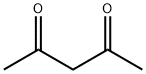
Acetylacetone , AR,99% , 123-54-6
Synonym(s):
2,4-Pentanedione;ACAC
CAS NO.:123-54-6
Empirical Formula: C5H8O2
Molecular Weight: 100.12
MDL number: MFCD00008787
EINECS: 204-634-0
PRODUCT Properties
| Melting point: | -23 °C (lit.) |
| Boiling point: | 140.4 °C (lit.) |
| Density | 0.975 g/mL at 25 °C (lit.) |
| vapor density | 3.5 (vs air) |
| vapor pressure | 6 mm Hg ( 20 °C) |
| refractive index | n |
| Flash point: | 66 °F |
| storage temp. | Store below +30°C. |
| solubility | H2O: soluble1 in 8 parts |
| pka | 8.9(at 25℃) |
| form | Liquid |
| color | very deep green-yellow |
| Relative polarity | 0.571 |
| Odor | pleasant odor |
| PH | 6 (200g/l, H2O, 20℃) |
| explosive limit | 2.4-11.4%(V) |
| Water Solubility | 16 g/100 mL (20 ºC) |
| Thermal Conductivity | 0.15 W/(m·K) at 25 ℃ |
| Merck | 14,81 |
| BRN | 741937 |
| Henry's Law Constant | 8.5×10⁻¹ mol/(m3Pa) at 25℃, Brockbank (2013) |
| Exposure limits | ACGIH TLV-TWA:25 ppm (102 mg/m3) |
| Dielectric constant | 23.1(20℃) |
| Major Application | cleaning products cosmetics environmental flavors and fragrances food and beverages personal care |
| Cosmetics Ingredients Functions | ADHESIVE |
| InChI | 1S/C5H8O2/c1-4(6)3-5(2)7/h3H2,1-2H3 |
| InChIKey | YRKCREAYFQTBPV-UHFFFAOYSA-N |
| SMILES | CC(=O)CC(C)=O |
| LogP | 0.68 at 20℃ |
| CAS DataBase Reference | 123-54-6(CAS DataBase Reference) |
| NIST Chemistry Reference | Acetylacetone(123-54-6) |
| EPA Substance Registry System | Acetylacetone (123-54-6) |
Description and Uses
Acetylacetone (2,4-pentanedione) is a clear or slightly yellowish liquid with a putrid odor. It is readily soluble in water and organic solvents, but is incompatible with light, ignition sources, excess heat, oxidizing agents, strong reducing agents, and strong bases. Upon decomposition, acetylacetone releases hazardous products such as carbon monoxide, carbon dioxide, and irritating, toxic fumes. Acetylacetone is used in the production of anticorrosion agents and its peroxide compounds, which serve as radical initiators for polymerization applications. It is also utilized as a chemical intermediate for pharmaceuticals (such as sulfamethazine, nicarbazine, vitamin B6, and vitamin K) and sulfonylurea herbicides. Furthermore, it serves as an indicator for the complexometric titration of Fe(III), for the modification of guanidino and amino groups in proteins, and in the preparation of metal acetylacetonates for catalytic applications.
Acetyl acetone is used as a reagent fororganic synthesis and as a transition metalchelating agent. Its organometallic complexes are used as additives for gasoline andlubricants, and in varnishes, color, ink, andfungicides.
Safety
| Symbol(GHS) |    GHS02,GHS06,GHS08 |
| Signal word | Danger |
| Hazard statements | H311+H331-H302-H370-H335-H412-H226 |
| Precautionary statements | P501-P273-P260-P270-P240-P210-P233-P243-P241-P242-P271-P264-P280-P370+P378-P308+P311-P361+P364-P303+P361+P353-P301+P312+P330-P304+P340+P311-P403+P233-P403+P235-P405 |
| PPE | Eyeshields, Faceshields, Gloves, type ABEK (EN14387) respirator filter |
| Hazard Codes | Xn,Xi |
| Risk Statements | 11-36/37/38-22-10-R22-R10-20/21/22-2017/10/22 |
| Safety Statements | 21-23-24/25-36-26-S24/25-S23-S21 |
| RIDADR | UN 2310 (PENTANE-2,4-DIONE) |
| WGK Germany | 1 |
| RTECS | SA1925000 |
| F | 9-23 |
| Autoignition Temperature | 662 °F |
| TSCA | TSCA listed |
| HS Code | 2914 19 90 |
| HazardClass | 3 |
| PackingGroup | III |
| Storage Class | 3 - Flammable liquids |
| Hazard Classifications | Acute Tox. 3 Dermal Acute Tox. 3 Inhalation Acute Tox. 4 Oral Flam. Liq. 3 |
| Hazardous Substances Data | 123-54-6(Hazardous Substances Data) |
| Toxicity | LC50 (4 hrs) in rats: 1000 ppm (Carpenter) |
| REACH Registrations | Active |
| Limited Quantities | 5.0 L (1.3 gallons) (liquid) |
| Excepted Quantities | Max Inner Pack (30g or 30ml) and Max Outer Pack (1Kg or 1L) |